



Groundwater open day – Project CLEPSYDRA
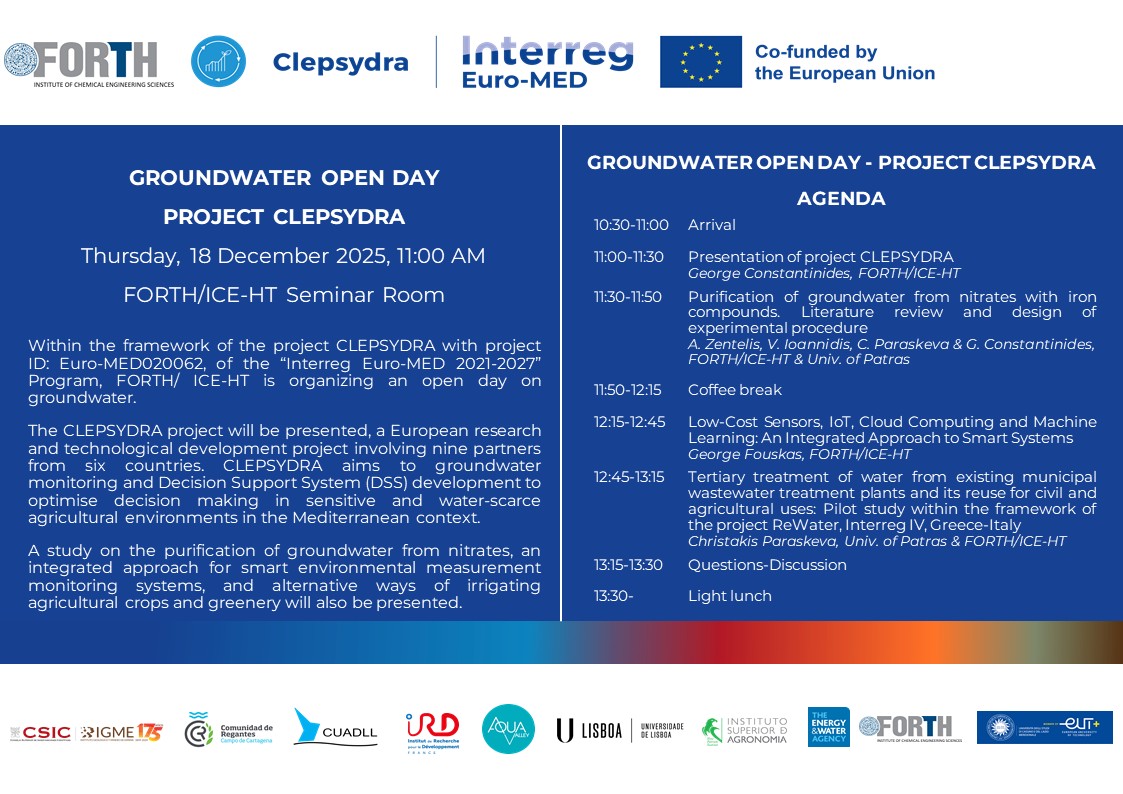
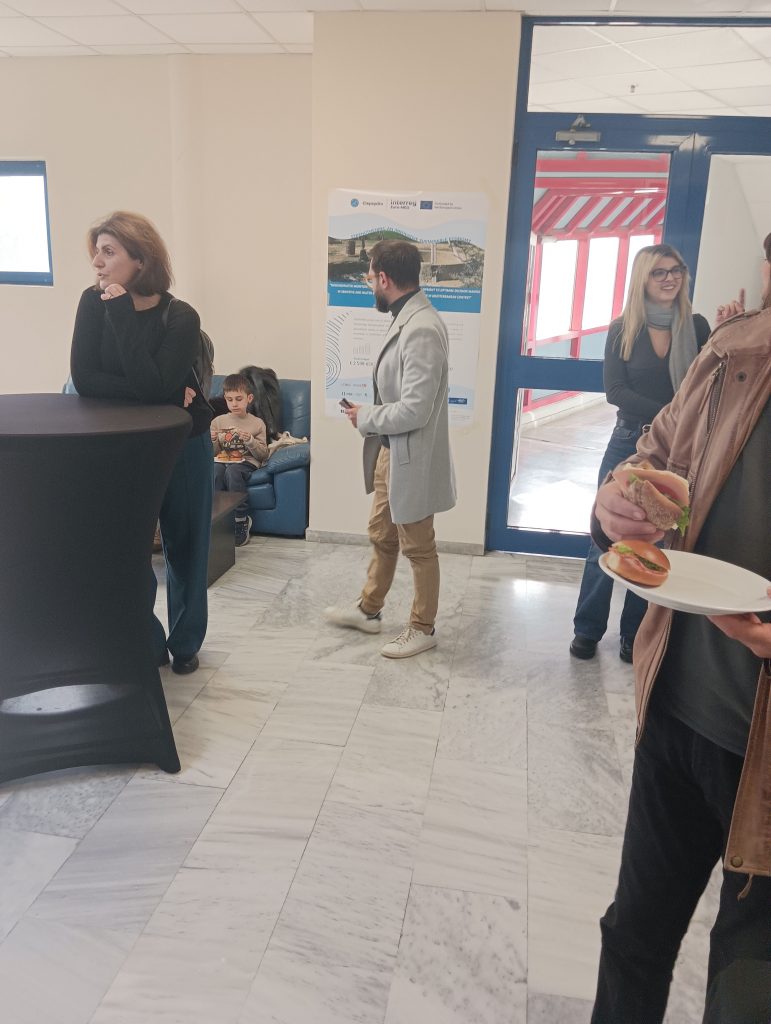
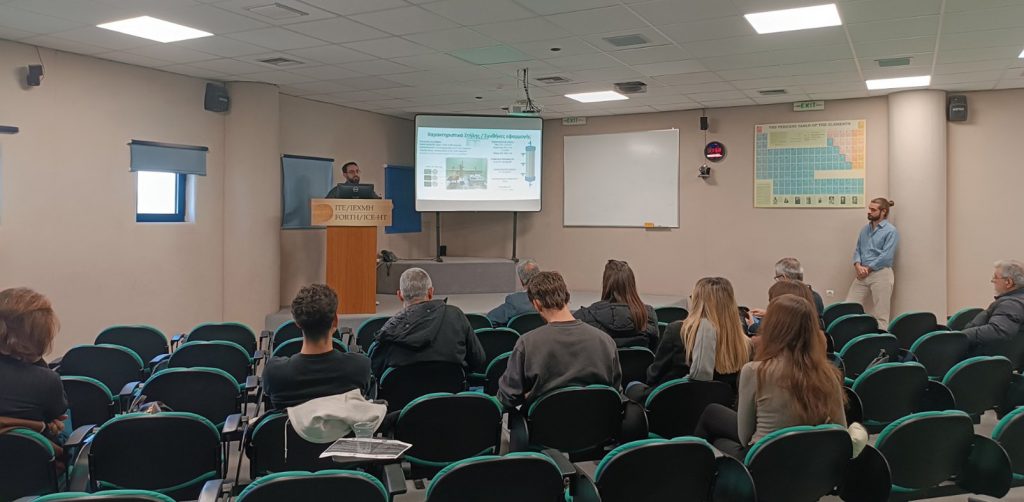
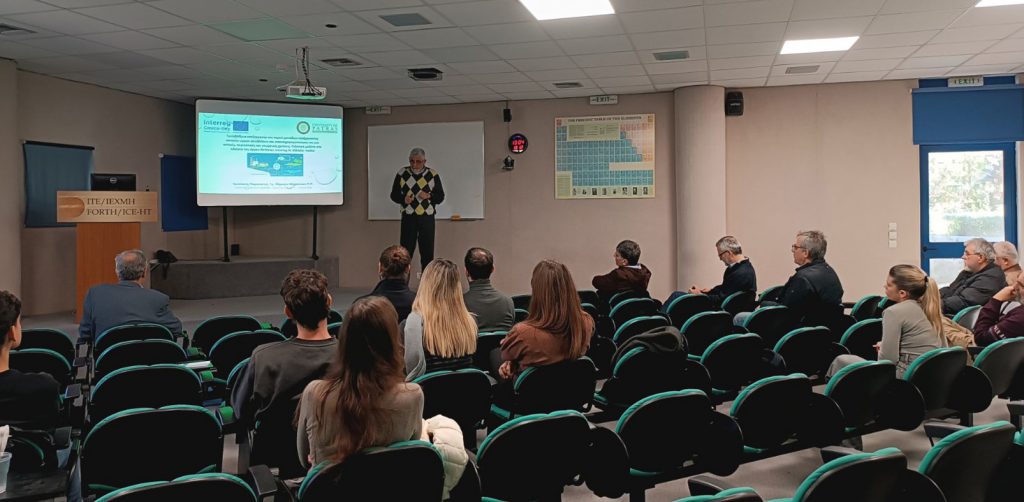
FORTH/ICE-HT organized the Groundwater Open Day on 18 December 2025 at the Seminar Room of the facility of the Institute. The main objectives of the event were to raise groundwater awareness and to present the CLEPSYDRA Project. Invitations were sent by e-mails and the invitation/agenda was published on LinkedIn and the website of the Institute.
The first talk by Dr. George Constantinides, PI of the project, included an extensive introduction on groundwater, a vital, often overlooked, freshwater source, which is replenished by precipitation, moves slowly in soil, and supports ecosystems, drinking water and irrigation, although it is vulnerable to pollution and overuse. Data of groundwater pollution and in particular groundwater nitrification in Europe were also presented. In this context, the importance of the CLEPSYDRA project was presented as it aims to monitor groundwater and develop the Decision Support System (DSS) to optimise decision making in sensitive and water-scarce agricultural environments in the Mediterranean context. The DSS will be based on Artificial Intelligence and specifically on Machine Learning and will help members of public administrations, decision makers and water managers to use groundwater in a sustainable way avoiding pollution and overuse.
The second presentation by Mr. V. Ioannidis and A. Zentelis, PhD candidates, included a review of groundwater pollution by nitrates and procedures for decontamination using inorganic compounds. This review also covered topics such as sources of nitrification, the effects of nitrates on human health, the distribution of nitrates in groundwater around the world, research results of denitrification by salts of iron or other heavy metals, the available chemical and instrumental methods at FORTH/ICE-HT to measure nitrates and relevant compounds and experimental procedures for water denitrification by iron compounds.
The third talk by Dr. George Fouskas addressed an integrated approach to smart systems, that is, from low-cost sensors measuring environmental parameters to acquisition, storage and processing of data for reliable forecasting. The low-cost sensors used have usually limited accuracy and precision calibration issues and should be complemented with existing regulatory-grade networks. Dynamic and Machine-Learning-based calibration can mitigate the problem. The appropriate IoT platform secures connectivity, messaging and remote management. Data storage is achieved by Cloud Data which ensures high security and easy access. Machine Learning algorithms, and probably in combination with physical models, can give reliable forecasting.
In the last talk, the installation of the pilot ultrafiltration unit was presented by Prof. Christakis Paraskeva for tertiary treatment of the effluent water from the existing municipal sewage waste treatment plant of Patras. Ultrafiltration membranes are used to trap large contaminants like bacteria, viruses, suspended solids, and colloids, providing water suitable for civil and agricultural uses and reducing marine pollution. The technical and operational characteristics of the unit, the chemical, physicochemical and biological analyses of the treated water, the legal framework were discussed and several actions for the utilization of the produced water were proposed. This pilot study was performed within the framework of the project ReWater – Eco technologies for the waste water management, Interreg IV, Greece-Italy.
During the Questions/Discussion session, most of the discussion was focused on the effects of nitrates on human health and ways to avoid groundwater nitrification.
The event attracted members of the Institute and the University (mainly PhD candidates), representatives of local regional authorities responsible for water management and engaged citizens.
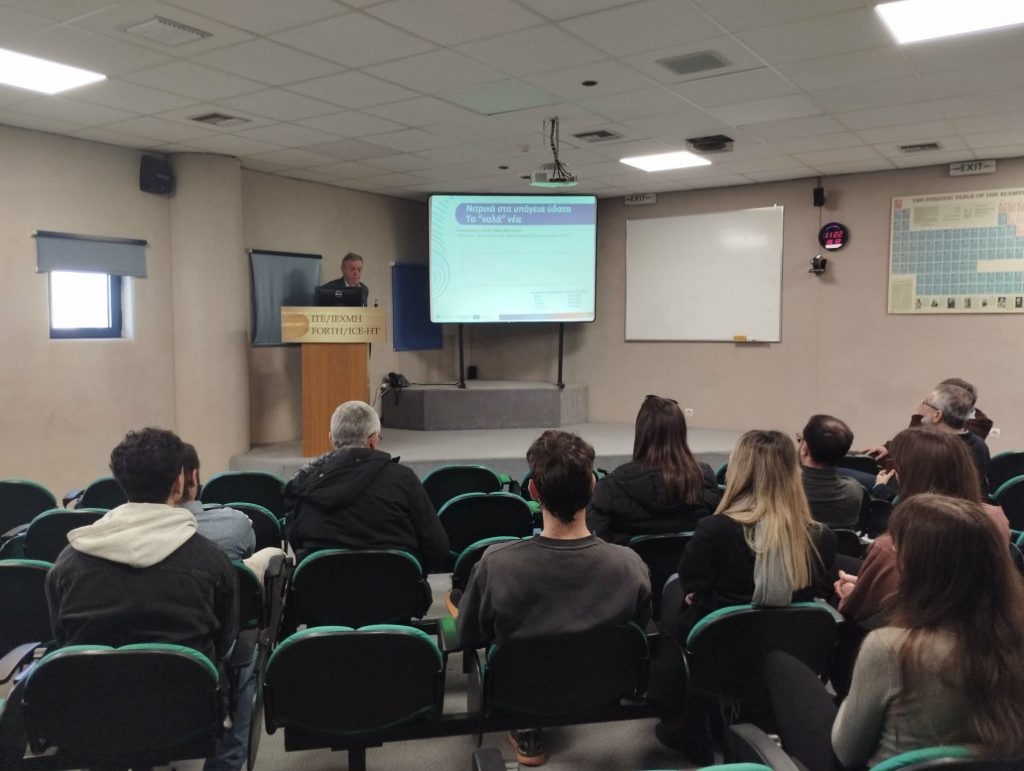
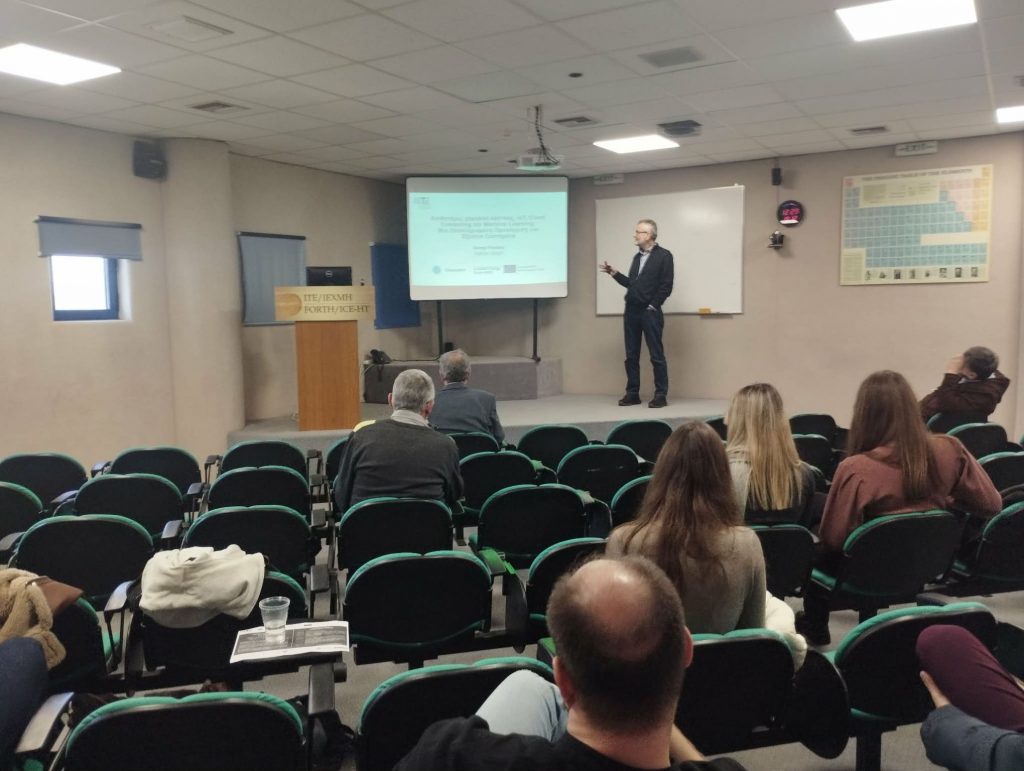
FORTH/ICE-HT Seminar Room
Stadiou Str., Platani, GR-26504, Patras, Hellas
FORTH/ICE-HT
Stadiou Str., Platani
www.iceht.forth.gr