


Διακεκριμένες Διαλέξεις “Αλκιβιάδης Χ. Παγιατάκης”
Οι Διακεκριμένες Διαλέξεις “Αλκιβιάδης Χ. Παγιατάκης” διοργανώνονται κάθε χρόνο από το Ινστιτούτο Επιστημών Χημικής Μηχανικής του Ιδρύματος Τεχνολογίας και Έρευνας (ΙΤΕ / ΙΕΧΜΗ), στην Πάτρα, στη μνήμη του Αλκιβιάδη Χ. Παγιατάκη (1945-2009), Καθηγητή του Τμήματος Χημικών Μηχανικών του Πανεπιστημίου Πατρών, Διευθυντή του ΙΤΕ / ΙΕΧΜΗ (1999-2006), και Προέδρου του ΙΤΕ από το 2006 μέχρι τον πρόωρο θάνατό του, στις 29 Νοεμβρίου 2009.
Στη συμπλήρωση ενός έτους από το θάνατό του, το ΙΤΕ/ΙΕΧΜΗ και το Τμήμα Χημικών Μηχανικών του Πανεπιστημίου Πατρών συνδιοργάνωσαν Συμπόσιο στη μνήμη του εκλιπόντος Προέδρου του ΙΤΕ, καθηγητή Α. Χ. Παγιατάκη, που πραγματοποιήθηκε στις 17 Δεκεμβρίου 2010 στο Συνεδριακό Κέντρο του Πανεπιστημίου Πατρών. Το Πρόγραμμα του Συμποσίου συμπεριελάμβανε ομιλίες από παλιούς μαθητές, συνεργάτες, φίλους και την οικογένεια του εκλιπόντος. Στους συμμετέχοντες στο Συμπόσιο διενεμήθη Λεύκωμα με τίτλο “Αλκιβιάδης Χ. Παγιατάκης: Η ζωή και το έργο του, 1945 – 2009“. Κατά τη διάρκεια του Συμποσίου πραγματοποιήθηκε ονοματοδοσία του “Κτηρίου Α. Χ. Παγιατάκη” στο χώρο του ΙΤΕ/ΙΕΧΜΗ.
Κεντρικοί ομιλητές των Διακεκριμένων Διαλέξεων “Αλκιβιάδης Χ. Παγιατάκης” είναι διεθνώς αναγνωρισμένοι επιστήμονες.
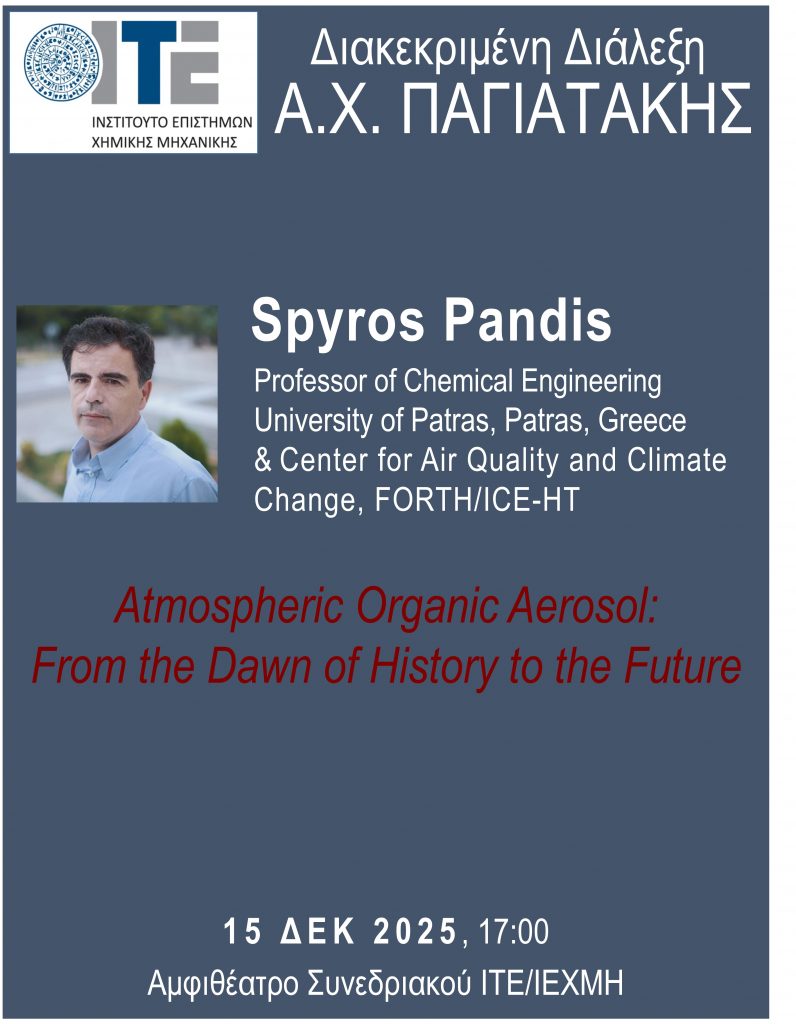
Διακεκριμένη Διάλεξη “Αλκιβιάδης Χ. Παγιατάκης” 2025
Αtmospheric Οrganic Aerosol:
From the Dawn of History to the Future
Spyros Pandis
Department of Chemical Engineering, University of Patras
Abstract
Atmospheric chemistry occurs within a fabric of complicated atmospheric dynamics and physics. This interplay often results in nonlinear and often counterintuitive changes of the system when anthropogenic emissions change. Atmospheric particulate matter is one of the most fascinating components of this system. Atmospheric particles can cause health problems, visibility reduction, contribute to acidic deposition and material damage, but also are a major player in the energy balance of the planet. A major goal of our research has been to gain a predictive understanding of the physical and chemical processes that govern the dynamics, size, and chemical composition of atmospheric aerosols. This talk focuses on the formation and evolution of organic aerosol (OA), probably the most uncertain component of atmospheric particulate matter.
The chemical complexity of OA (hundreds or thousands of compounds) poses a formidable scientific challenge. Until recently, organic particulate material was simply classified as either primary or secondary with the primary component being treated in models as nonvolatile and inert. However, this oversimplified view fails to explain the highly oxygenated nature of ambient OA, the relatively small OA concentration gradients between urban areas and their surroundings, and the concentrations of OA during periods of high photochemical activity. A unifying framework for the description of all components based on their volatility distribution (the volatility basis set) can be used for the treatment of a wide range of processes affecting organic aerosol loadings and composition in the atmosphere. The combination of this new framework with the recent results of laboratory studies can resolve some of the discrepancies between OA observations and laboratory results. Examples of the application of this framework in laboratory and field studies as well as urban, regional, and global air quality problems will be discussed.
Short CV
Spyros Pandis is Professor in the Chemical Engineering Department of the University of Patras in Greece and co-director of the Center for Air Quality and Climater Change in the Foundation for Research and Technology, Hellas (FORTH). He received his PhD from the California Institute of Technology in 1991 and joined the faculty of Carnegie Mellon University in 1993 and of the University of Patras in 2004. His research includes theoretical and experimental studies of atmospheric chemistry as it relates to urban and regional pollution and global climate change. Prof. Pandis has published over 300 peer-reviewed papers, and he is the author together with Prof. Seinfeld of “Atmospheric Chemistry and Physics” a textbook that is widely used around the world. He has been awarded the Fuchs Award by the International Aerosol Research Assembly, the Whitby and Sinclair Awards by the American Association for Aerosol Research, the Cecil Award in Environmental Engineering by the American Institute of Chemical Engineering, the Bjerkness Medal by the European Geophysical Union, and the CAREER award by the US National Science Foundation. He has been the recipient of the Kun Li, the Benjamin Teare and the University of Patras awards for Excellence in Engineering education.